0%

China’s top luxury kitchen cabinet manufacturers serve a market where visual impact must meet daily performance. Luxury Kitchen Cabinets are more than polished doors and stone counters. They depend on precise joinery, durable finishes, thoughtful storage, and installation that fits the room. Kitchen designer Johnny Grey has described the kitchen as “the engine of the house.” That idea matters when comparing makers: a beautiful display should still work through busy mornings, shared meals, and years of use.

This guide introduces ten Chinese manufacturers for buyers exploring bespoke and premium kitchen solutions. It considers design range, material options, production capabilities, customization, quality controls, and international project experience. These criteria help frame a useful comparison; they do not guarantee that one supplier suits every home or project. A careful buyer should confirm specifications, inspect finish samples, clarify hardware brands, and review installation support before placing an order.

Look closely at the details. A lacquered door may appear flawless under showroom lighting, yet reveal uneven color beside a sunlit window. A drawer can glide smoothly when empty and feel less convincing when fully loaded. These small checks are easy to overlook. They also deserve more attention than a dramatic render. The manufacturers featured here offer different strengths, from contemporary minimalism to richly grained wood cabinetry. Their place in the list is a starting point, not a substitute for factory verification, clear contracts, and project-specific due diligence.
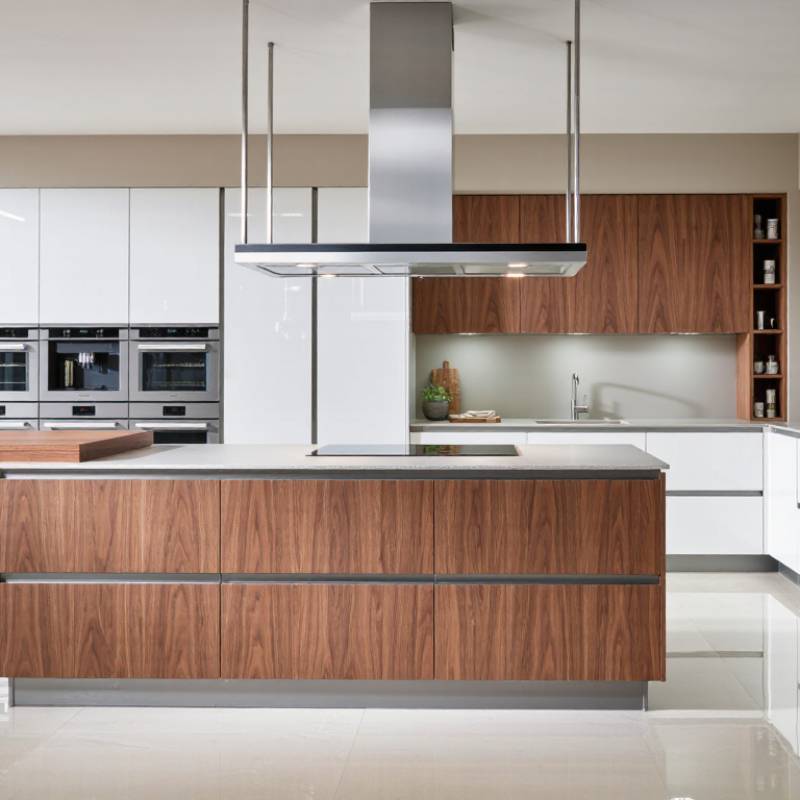
China Top 10 Luxury Kitchen Cabinet Manufacturers

What Defines a Luxury Kitchen Cabinet Manufacturer in China?

A luxury kitchen cabinet manufacturer in China is defined by more than polished showroom doors. The real test is how carefully the company turns room measurements into buildable plans. Walls are rarely perfectly square, and a few millimeters can affect drawer alignment or appliance clearance. Skilled teams check these details before production and provide clear shop drawings for review.

Materials and construction matter, but claims should be specific. Ask for cabinet-box materials, edge-banding details, finish samples, and hardware specifications. Compare samples in daylight; a glossy display can make colors look different from those at home. Details matter. A capable manufacturer can explain its quality checks and show how it manages moisture-prone areas, such as the sink cabinet. A beautiful finish alone proves little.

Reliable manufacturers also communicate clearly across design, production, packing, and installation. Request a sample order, written tolerances, production milestones, and records of inspections. Ask how replacement parts and damage claims are handled, too. A factory visit can help, but it is not a guarantee. Even a well-organized supplier may miss a detail, so confirm dimensions and approvals in writing before production begins. Luxury is partly craftsmanship, partly dependable follow-through, and sometimes the willingness to admit what still needs checking.

How China’s Luxury Kitchen Cabinet Industry Is Structured

China’s luxury kitchen cabinet industry is not one factory type; it is a connected supply chain. Material suppliers provide engineered panels, veneer, stone, metal fittings, glass, and surface finishes. Specialist workshops may handle doors, drawer systems, lacquer, or custom metal details. Precision matters. Small tolerance errors can show at a long island seam or around a flush appliance panel.

Cabinet manufacturers sit at the center, coordinating design, production, quality checks, and packaging. Some focus on domestic projects, while others build for overseas distributors or project partners. Their work may include shop drawings, sample approval, moisture control, and hardware testing. A premium order often depends on coordination more than on one expensive material. Not always seamless. A beautiful sample does not guarantee identical color across every production batch.

Design studios, project managers, installers, and logistics providers complete the structure. In larger developments, measurements and installation schedules must match site conditions, not just drawings. Export-oriented suppliers may adapt cabinet dimensions, finishes, and documentation to buyer requirements. Yet “luxury” has no single factory definition; it can mean tailored sizing, a stable finish, quiet hardware, or careful after-sales support. Buyers should ask who oversees each stage, how defects are recorded, and what happens when a replacement panel is needed. The chain is capable, but it is not flawless.

Profiles of China’s Top 10 Luxury Kitchen Cabinet Manufacturers

Profiles of China’s Top 10 Luxury Kitchen Cabinet Manufacturers offer a practical way to compare design strengths, construction methods, and service capabilities. Rather than treating “luxury” as a finish alone, look at cabinet-box materials, door construction, hardware options, and the precision of fitted panels. Some manufacturers may emphasize custom sizing, while others focus on coordinated storage and consistent production. These profiles help readers identify useful differences without assuming that one factory suits every project.

Tips: Ask for a material sample. Check edge details and hinge movement. Request written specifications, installation scope, and warranty terms before comparing quotations.

A polished showroom tells only part of the story. Ask how measurements are checked, how changes are documented, and who handles installation questions. Confirm whether quoted prices include delivery, fitting, and finishing work. These details can affect the final result as much as cabinet design. One limitation is that public profiles may not show actual production quality. If possible, review a completed kitchen or inspect a sample door under natural light. Small color shifts happen. They are worth discussing early.

China Top 10 Luxury Kitchen Cabinet Manufacturers - Profiles of China’s Top 10 Luxury Kitchen Cabinet Manufacturers An anonymized, standards-based comparison framework. The entries below are assessment dimensions—not named companies, audited rankings, or manufacturer-specific claims.
Profile Capability dimension Verifiable benchmark or data point Evidence to check
01 Low-emission panel selection China’s GB/T 39600-2021 classifies wood-based panels: ENF ≤0.025 mg/m³, E0 ≤0.050 mg/m³, and E1 ≤0.124 mg/m³. Panel test report identifying the product, emission class, test method, and issuing laboratory.
02 Chinese formaldehyde compliance GB 18580-2017 sets a formaldehyde emission limit of ≤0.124 mg/m³ for covered wood-based panels and products. Current test documentation for the specific panel or finished product offered.
03 North American export readiness CARB Phase 2 limits differ by composite-wood category: 0.05 ppm for hardwood plywood, 0.09 ppm for particleboard, and 0.11 ppm for MDF (0.13 ppm for thin MDF). Applicable product-category test reports and, where required, third-party certification records.
04 Kitchen-unit safety and performance EN 14749 covers safety requirements and test methods for domestic and kitchen storage units and worktops. Test reports that state the tested configuration and identify the standard edition used.
05 Storage-unit strength and durability ISO 7170 specifies methods for determining the strength and durability of storage units. Test results for representative cabinet configurations, including the tested loads and components.
06 Hinge performance EN 15570 specifies strength and durability test methods for furniture hinges and their components. Hardware test report identifying the hinge model and test conditions.
07 Drawer-runner performance EN 15338 specifies strength and durability test methods for furniture extension elements and their components. Test documentation for the actual runner system used in the proposed cabinetry.
08 Quality-management system ISO 9001:2015 is the international standard for quality-management systems; certification applies to a defined organization and scope. Valid certificate, certified-site list, scope, and certification-body details.
09 Environmental-management system ISO 14001:2015 specifies requirements for an environmental-management system; it is not a product-level environmental rating. Valid certificate and confirmation that the manufacturing site and relevant activities are within scope.
10 Responsible wood sourcing FSC chain-of-custody certification tracks forest-based materials through the supply chain; a claim depends on valid certification and product scope. Current certificate code, certificate scope, and product-specific claim documentation.

How the Manufacturers Compare in Design, Materials, and Production

Comparing China’s luxury kitchen cabinet manufacturers requires more than judging showroom appearance. Look at door proportions, edge alignment, handle placement, and how finishes meet around corners. A restrained design may suit a compact apartment, while a framed door can add depth to a larger kitchen. Ask for full-size samples; small swatches rarely show how color shifts under warm or cool lighting. Small details matter.

Materials influence appearance and long-term performance. Compare cabinet-core type, veneer or lacquer thickness, edge sealing, and hardware specifications rather than relying on broad labels such as “premium.” In humid kitchens, sealed edges and stable panels can help reduce swelling, but installation and ventilation also affect results. Not always. A heavier panel is not automatically a better one.

Production capacity matters when a project needs consistent dimensions across many cabinets. Ask how measurements are checked, how surface defects are recorded, and whether replacement parts can be matched to the original finish. Automated cutting may improve repeatability, yet careful hand-finishing still matters on visible edges. Request a sample door and a written specification before approving a large order. It may feel cautious, but comparing documents with the physical sample can reveal mismatches early.

Key Factors for Evaluating and Sourcing Luxury Kitchen Cabinets in China

Luxury sourcing is not just a matter of choosing a glossy finish. Global Market Insights estimated that the kitchen cabinet market exceeded US$90 billion in 2022, with growth projected through 2032. This broad market estimate is useful context, but it does not verify a supplier’s quality. Ask for construction drawings, material specifications, and a sample door made with the same finish and edge treatment as the final order.

Check the cabinet core, hardware, and finish as separate components. Request test reports that identify the tested product, method, and date; a certificate without traceable product details is weak evidence. Compare panel thickness, hinge adjustment, drawer load ratings, and coating resistance to stains and moisture. Details matter. Inspect a full-size sample under warm and cool lighting, since color can shift noticeably. Confirm tolerances and replacement-part availability in writing, not only in a sales conversation.

The National Kitchen & Bath Association’s 2024 Kitchen Trends Report offers useful insight into design preferences, but trend data cannot replace factory checks. Review production samples, inspect packaging, and ask how damaged panels are handled. For distant projects, verify that drawings match site measurements and appliance clearances before production. One limitation is easy to overlook: a polished showroom sample may not represent batch consistency. Request dated photos or inspection records from the actual production run, and keep an approved reference sample.

China Luxury Kitchen Cabinet Sourcing: Key Evaluation Factors

Suggested evaluation weights for comparing suppliers—not market survey results. Assess material and finish quality, customization capability, hardware, compliance documentation, production quality control, installation support, lead time, and warranty terms against your project requirements.

FAQS

What should define a luxury kitchen cabinet manufacturer?

Careful measurements, clear shop drawings, and dependable follow-through matter. A polished showroom alone proves little.

Which material details should buyers compare?

Ask about cabinet-core materials, edge sealing, finish thickness, and hardware specifications. Compare samples in daylight.

Why are full-size samples useful?

Small swatches can hide color shifts and edge details. Lighting changes the appearance. Details matter.

How can buyers assess production quality?

Ask how dimensions and surface defects are checked. Request written tolerances and inspection records.

Does a heavier cabinet panel mean better quality?

Not always. Stable materials, sealed edges, installation, and ventilation all affect performance.

Who may be involved in making a cabinet order?

Material suppliers, specialist workshops, manufacturers, designers, installers, and logistics teams may all contribute. Coordination can be imperfect.

What should buyers confirm before production begins?

Confirm dimensions, finish samples, specifications, and approvals in writing. I would still double-check the drawings.

Does a factory visit guarantee a flawless order?

No. A visit can help, but details may still be missed. Ask how damaged parts and replacements are handled.

Conclusion

China’s luxury kitchen cabinet industry combines advanced manufacturing capabilities with a wide range of design and customization options. This article explains what distinguishes a luxury cabinet manufacturer, from design expertise and material selection to craftsmanship, quality control, and production capacity. It also explores how the industry is organized, including differences in specialization, service models, and the needs of domestic and international projects.

The profiles of ten manufacturers provide a framework for understanding the market without treating luxury as a single style or standard. Readers can compare approaches to design, materials, and production, then use practical criteria to evaluate potential suppliers. Key considerations include project requirements, customization flexibility, communication, manufacturing consistency, delivery planning, and after-sales support. Together, these insights help buyers make informed sourcing decisions and find Luxury Kitchen Cabinets that suit their design goals, quality expectations, and budget.

Ethan

Ethan

Ethan is a professional marketing specialist with a deep understanding of the company’s products and the needs of the people who use them. He regularly contributes expert articles to the company website, sharing clear, practical information to help readers understand product features, applications,......